Research
We investigate how neural circuits transform sensory information into movement decisions, and how experience, social context, and internal state shape flexible behaviour. Using locusts as a model system, we study how animals transition between behavioural states, how sensory cues and physiological condition drive these changes, and how neural mechanisms at multiple levels give rise to adaptive and collective behaviour. Our work combines quantitative behavioural analysis, virtual reality, neurophysiology, molecular approaches and field-based studies to link mechanisms across scales, from sensory coding to group dynamics.
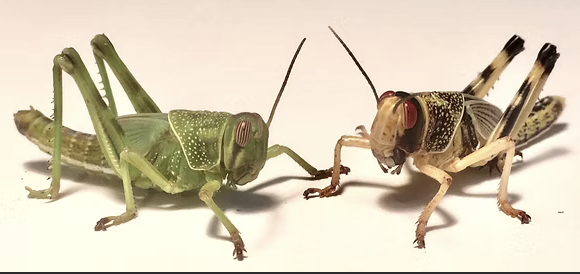
Phenotypic plasticity in the desert locust
Locusts provide a powerful system for studying how social experience reshapes behaviour. We investigate the dynamics of density-dependent phenotypic plasticity, asking how behavioural states shift, stabilise, and reverse across changing social and ecological contexts. By combining quantitative tracking, naturalistic group assays, and controlled virtual environments, we study the structure of individual behaviour, social interactions, and collective dynamics, and the processes through which these are reorganised during transitions between behavioural states.
Multisensory integration, internal state, and action
Adaptive behaviour depends on how animals integrate external sensory information with internal physiological state. We study how visual motion, olfactory cues, and nutritional condition interact to shape attraction, foraging, and social decisions. This work asks how behavioural responses are modulated across contexts, how relevant cues are selected and transformed into action, and how active sensing and state-dependent sampling shape the acquisition and use of sensory information.
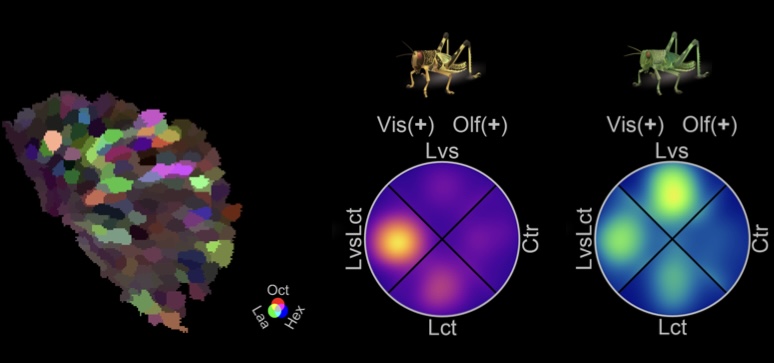
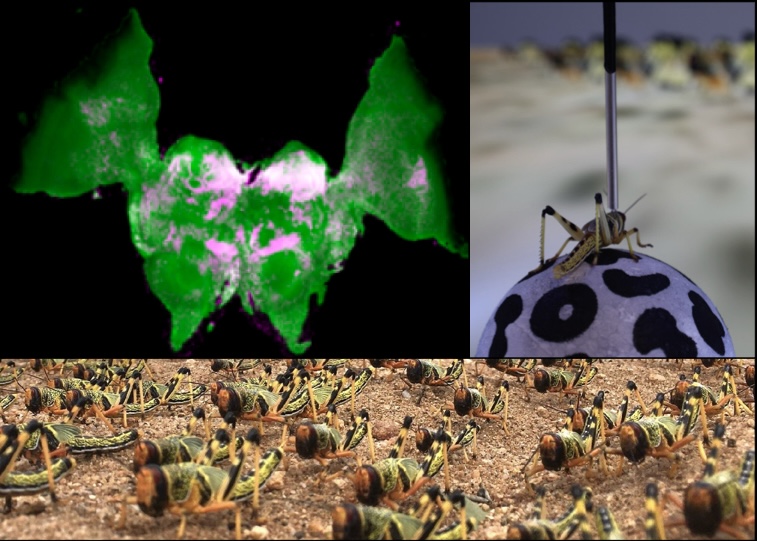
Circuit mechanisms of adaptive and collective behaviour
We investigate how neural circuits generate flexible behaviour and how social experience reshapes sensory processing. A major focus is the locust olfactory system, where we study how antennal-lobe circuits change across behavioural states and how these changes influence odour-guided behaviours such as foraging and social attraction. In parallel, we study the circuits and computations underlying visually guided movement and collective motion, combining virtual reality, electrophysiology, activity mapping, and theory to uncover how neural dynamics support adaptive behaviour and coordinated action in dynamic social environments.