COUZIN-FUCHS LAB
University of Konstanz · Centre for the Advanced Study of Collective Behaviour · Max Planck Institute of Animal Behavior
Neural and behavioural mechanisms of social plasticity and collective behaviour #
The ability to adapt to changing social environments is a fundamental feature of life. Locusts show a remarkable capacity to shift rapidly between solitary and gregarious lifestyles, making them an ideal model for studying social plasticity and the emergence of collective behaviour. By combining neurophysiology, virtual reality, and quantitative behavioural analysis, we investigate how social experience shapes neural function, behaviour, and swarm formation.
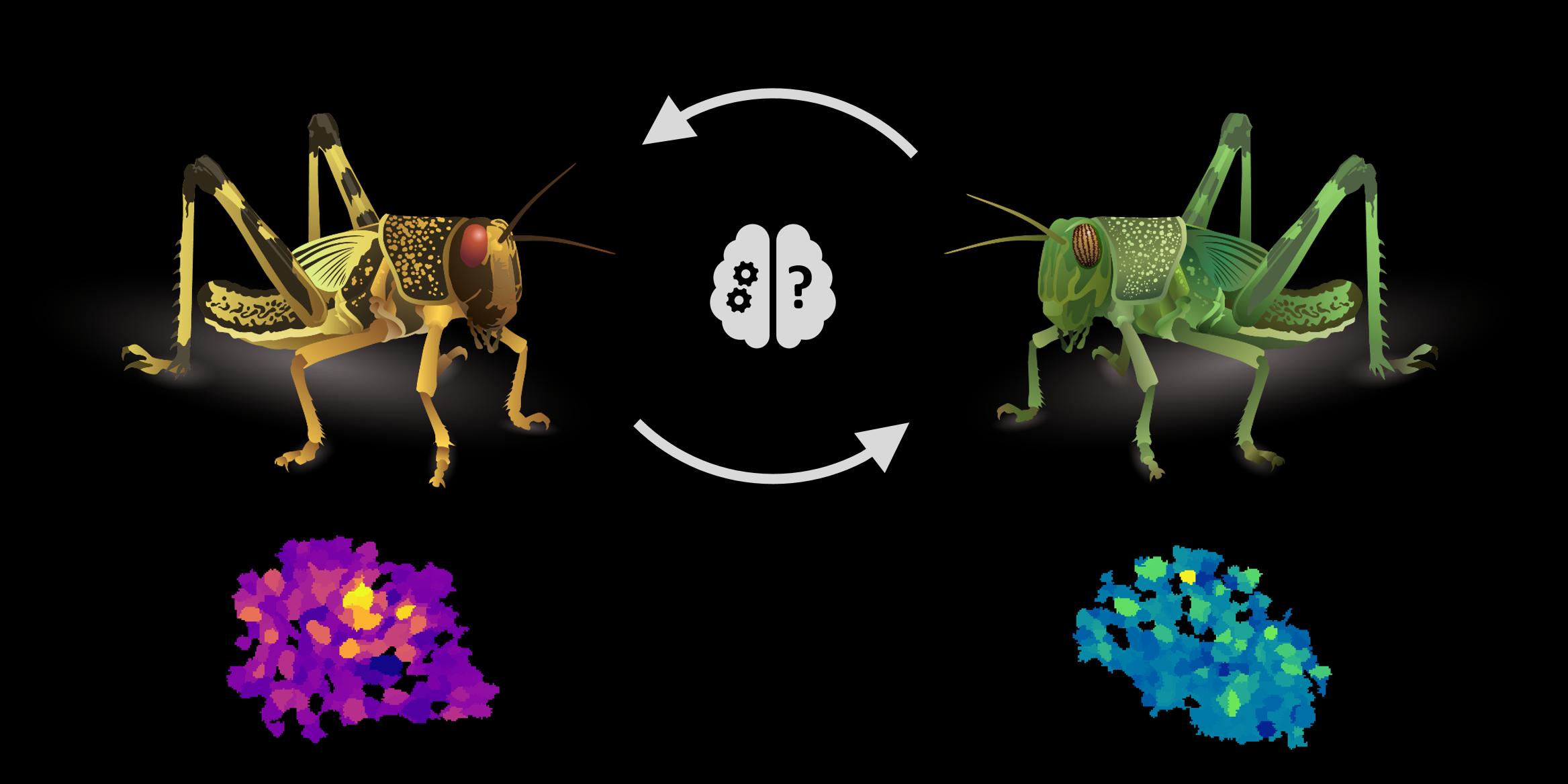
Calcium Imaging · Quantitative Behaviour · Virtual Reality
Contact
Couzin-Fuchs Lab
Department of Biology, University of Konstanz
Centre for the Advanced Study of Collective Behaviour