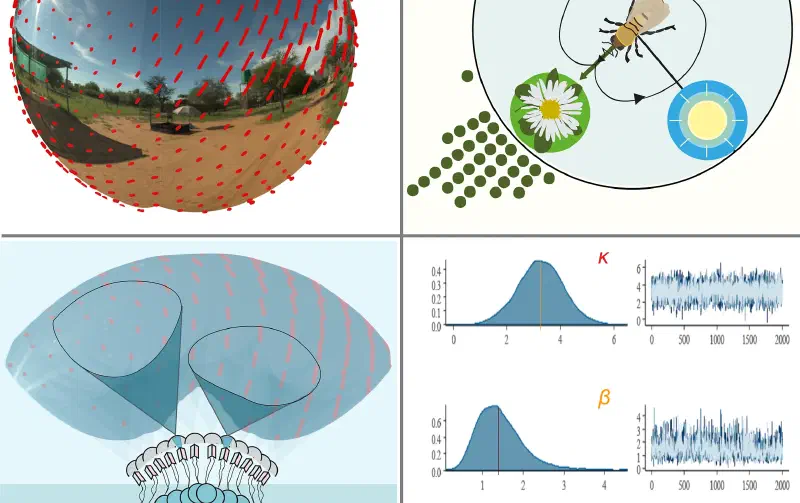
Our current research uses the “waggle dances” of honeybees to investigate compass navigation. Honeybees were the first
species shown to use a “polarization compass”, directing their foraging trips using patterns of polarization in the sky.
To do this, they employ a specialised region of their dorsal eye that can detect polarized light.
We aim to better understand how the honeybee’s “polarization compass” trades off flexibility against generalisation,
especially when faced with more challenging conditions, such as clouds, haze, and extremes of solar elevation that
distort the sky’s polarization pattern. To achieve this, we combine cutting-edge methods for analysis of waggle dances
with state-of-the-art statistical modelling and novel methods for reproducing polarized light in the lab.
Each year between April and September, we run behavioural experiments with honeybees, and welcome applications for
student assistant positions during this time.
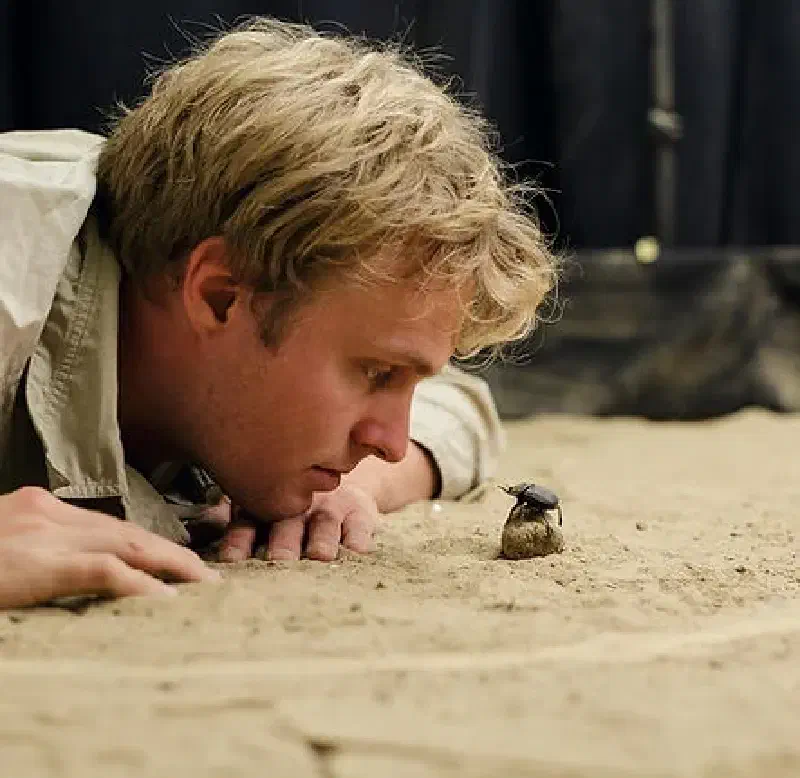
James Foster Prinicpal InvestigatorJames Foster did his B.Sc. in Zoology and Master of Research in Vision
Science at the University of Bristol, UK. During his PhD in “Functions of Animal Polarization Sensitivity” at University
of Bristol, he demonstrated the ability of bumblebees to learn, and actively choose, patterns of polarization associated
with food rewards—revealing a new channel for plant–pollinator communication (Foster et al., Curr. Biol., 2014). During
his postdoc at Lund University, he investigated the visual compass cues used by nocturnal dung beetles, establishing
methods for quantifying these cues and identifying the features critical for orientation accuracy. In 2020, James became
a research fellow at Julius-Maximilians-Universität Würzburg, Germany. In April 2022, he joined the neurobiology
department at University of Konstanz and CASCB as an affiliate member. James´s research focusses on how animals perceive
and respond to polarized light, a property of light imperceptible to humans that nonetheless guides the behaviour of
many animal species. His current research uses the “waggle dances” of honeybees to investigate compass navigation.
Frida Hildebrandt PhD StudentFrida likes bees and is particularly interested in navigation and
foraging of pollinating insects. Her PhD project in the Foster Lab investigates the propagation of social information
through groups of honeybees and locusts and how these species make navigational decisions using incomplete information
from their peers.
George Kolyfetis PhD StudentGeorge carried out his first Master Thesis at Ludwig Maximilian
University of Munich (LMU). The project revolved around the 3D reconstruction of retinal neurons in the European anchovy
Engraulis encrasicolus. Focusing on the adaptations of polarization vision in teleost fish, he used SEM images to
reconstruct the synaptic anatomy of the inner retina and study its architecture. For his second Master Thesis at Harvard
University, he studied the pangenome of three Scrub-Jay species (genus Aphelocoma). More specifically, he focused on the
complex evolution and structural variation in gene families related to perception, like opsins and olfactory receptor
genes.
George likes all animals and is very interested in all aspects of perception and sensory systems. His PhD project in the
Foster Lab deals with the modeling of honeybee polarization vision and navigation, i.e. how bees turn sky polarization
patterns into an internal compass.