
Bio#
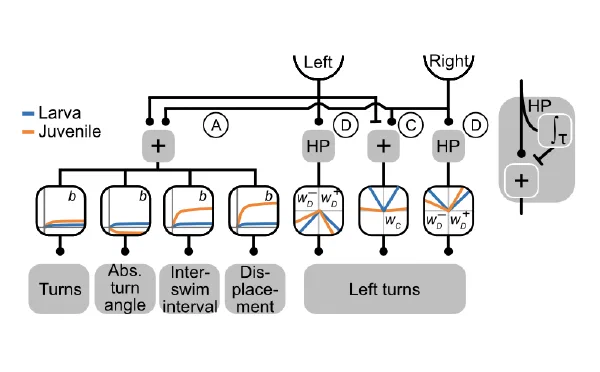
My PhD research investigates how brightness-guided navigation changes across zebrafish development. Using carefully designed visual stimuli and high-throughput behavioural experiments, I build algorithmic models of decision-making and test them using agent-based simulations. This approach revealed that larval and juvenile zebrafish use different brightness navigation strategies: a behavioural switch driven by a reweighting of three parallel processing streams.
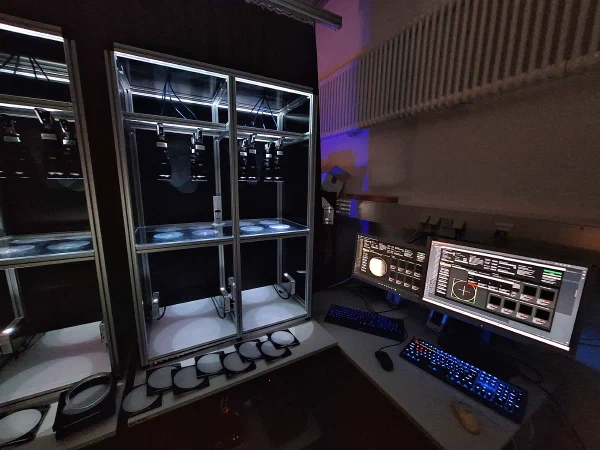
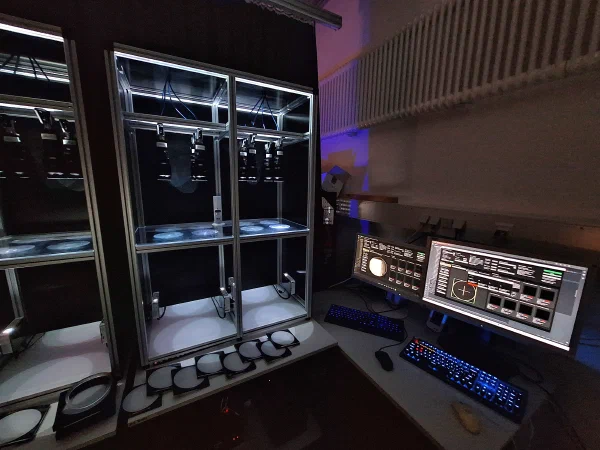
As the first PhD student in the Bahl lab, I contributed to building the experimental and computational infrastructure that the lab now runs on; from hardware setup to analysis pipelines and lab culture. I enjoy translating complex, high-dimensional datasets into clear and communicable conclusions, and have been recognised for this with presentation awards including at the IMPRS and the Göttingen Meeting.
Beyond the bench, I organised programming, data visualisation, and team culture workshops at both lab and department level, served as PhD representative at the Centre for the Advanced Study of Collective Behaviour (CASCB) across a consortium of 15+ research groups, co-organised the NeuroDoWo workshop, and contributed to the Grant Committee of the Doctoral Fund.
Outside the lab, I am drawn to problems where rigorous quantitative thinking meets real-world impact, including in pharma, biotech, and life sciences R&D.
Projects#
Methods#
Thesis#
CV#
Positions
Education
Awards
Publications#
2026
- Slangewal K., Aimon S., Capelle M. Q., Kämpf F., Naumann H., Slanchev K., Baier H., Bahl A. (2026) Visuomotor decision-making through multifeature convergence in the larval zebrafish hindbrain. Nature Communications. https://doi.org/10.1038/s41467-026-69633-4
2025
- Slangewal K., Aimon S., Capelle M. Q., Kämpf F., Naumann H., Baier H., Slanchev K., Bahl A. (2025) Parallel and convergent pathways for multifeature visual processing in larval zebrafish sensorimotor decision-making. https://doi.org/10.1101/2025.08.12.669772
- Capelle M. Q., Slangewal K., Eleftheriadis P. E., Bahl A. (2025) Behavioral algorithms of ontogenetic switching in larval and juvenile zebrafish phototaxis. https://doi.org/10.1101/2025.06.13.659371
- Reynolds P., Marchi D., Ling Y. T., Slangewal K., Capelle M., Chalakova Z., Bahl A., Hindges R. (2025) Early visual experience elicits cellular and functional plasticity in the retina and alters behaviour. https://doi.org/10.1101/2025.04.29.651180
2024
- Pflitsch P., Oury N., Krishnan K., Joo W., Lyons D. G., Capelle M., Herrera K. J., Bahl A., Rihel J., Engert F., Zwaka H. (2024) Sleep Disruption Improves Performance in Simple Olfactory and Visual Decision-Making Tasks. https://doi.org/10.1101/2024.11.02.621641