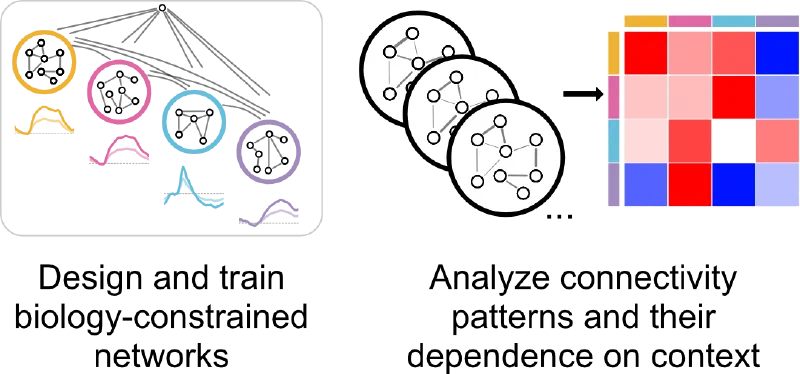
We develop recurrent neural networks (RNNs) designed to reproduce the population dynamics across both hemispheres of the larval zebrafish brain. Leveraging the unique multi-modal data accessible in this model organism, we integrate high-resolution calcium imaging with experimentally-derived anatomical and physiological constraints.
Architecture#
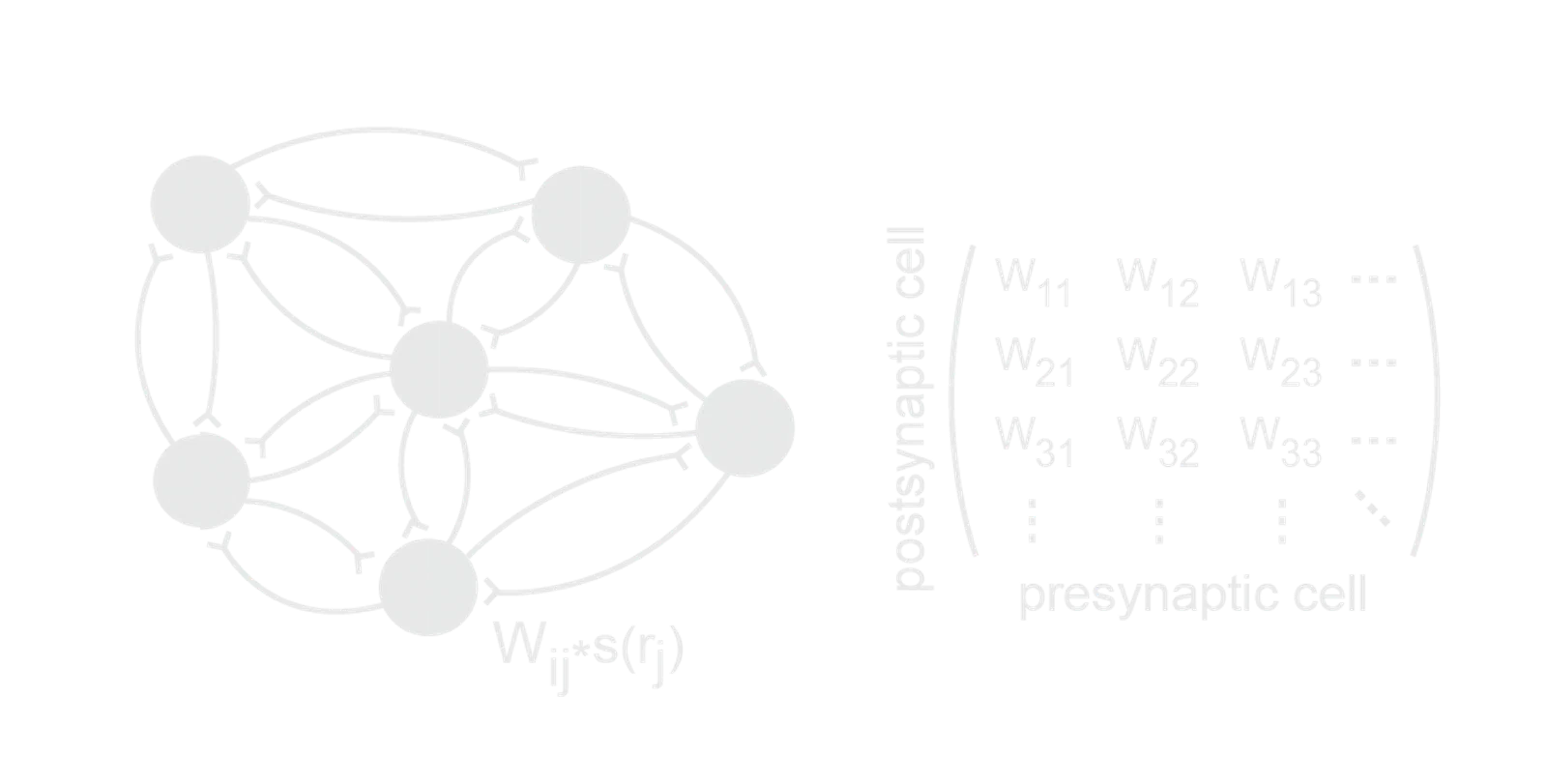
Our approach shifts the focus from individual neuron-intrinsic time constants to the shaping of timescales through structured recurrence. By utilizing a low-rank network framework, we enable long integration timescales in specific populations while maintaining overall network simplicity.
To ensure biological fidelity, our models are strictly grounded in:
- Dale’s Law: Maintaining fixed excitatory and inhibitory (E/I) identities for every neuron.
- Anatomical Sparsity: Implementing block-sparse wiring patterns and population-specific E/I ratios derived directly from connectomics data.
Functional Insights & Future Directions#
By embedding these measured structural motifs, we can investigate how biological constraints fundamentally dictate functional dynamics. Our current work focuses on identifying emergent connectivity motifs—patterns that consistently reappear across training runs—to reveal the underlying structural solutions the circuit employs to solve tasks.
Furthermore, we are investigating how contextual modulators, such as temperature variations, influence parameterization and circuit stability. This bridges the gap between low-level mechanistic wiring and the broader environmental factors that modulate behavior.